Machu Picchu
A fifteenth-century Inca estate on a ridge above the Urubamba river, and the reason most people first hear of Peru.
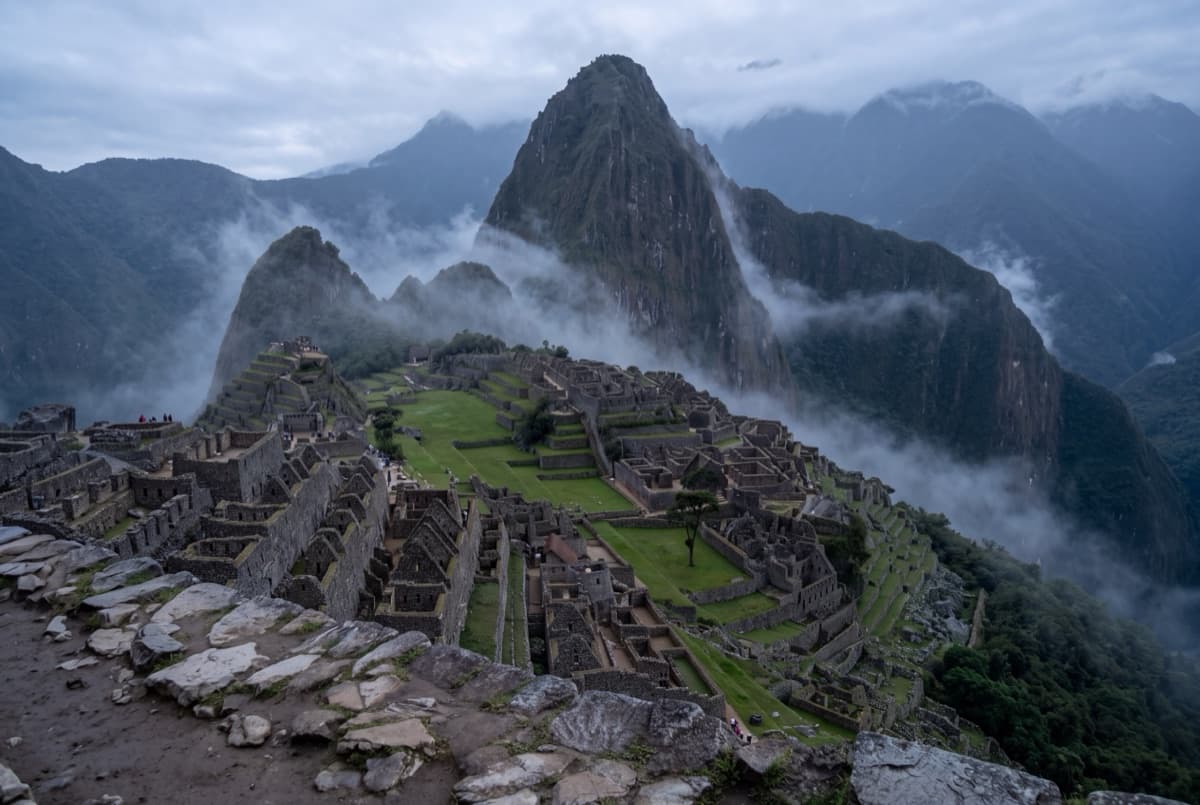
Machu Picchu sits on a narrow ridge 2,430 meters above sea level, between two peaks, with the Urubamba river bending around it far below. It was built in the middle of the fifteenth century, most likely as a royal estate for the Inca emperor Pachacuti, the ruler who turned Cusco from a regional capital into the center of the largest empire the Americas had seen. It was lived in for perhaps a hundred years, abandoned around the time of the Spanish conquest, and never found by the Spanish at all.
That last fact is why it looks the way it does. Everywhere else, the conquerors pulled Inca walls down and built churches on the foundations. Here the terraces, the temples, the fountains and the houses were simply left, under cloud forest, with the people of the valley still farming around them. When the American explorer Hiram Bingham arrived in 1911, guided there by local farmers who already knew the site, he did not discover it. He told the rest of the world about it.
What you see is Inca engineering at its most complete. Stone fitted without mortar so tightly that it has survived five centuries of earthquakes. Terraces that turn a mountainside into farmland and drain it at the same time. A carved stone, the Intihuatana, aligned to the sun. A temple with a window that catches the June solstice sunrise. Every element is placed in relation to the mountains around it, which the Incas treated as living beings, apus, and still do.
For us, Machu Picchu is both a source of pride and a working reminder. It was declared a Historic Sanctuary by Peru and a World Heritage site by UNESCO in 1983, and the number of people allowed in each day is limited to protect it. Treat the place the way the families of the valley do: as something you were allowed to visit, not something you own.
The walk matters as much as the arrival. The classic four-day Inca Trail follows an original Inca road through passes above 4,000 meters, past smaller sites that most visitors never see, and ends at the Sun Gate with the city laid out below you in the morning. If you can walk it, walk it. The ruins are the answer; the trail is the question they were built to answer.
Experience it
Book it
IncaTrail.com, our sister site, handles Inca Trail permits, entry tickets and the days in Cusco around them.
Related entries
Keep going
Heritage
Inti Raymi
Heritage
Quechua
Made in Peru
Alpaca and Andean Textiles